


An in-depth analysis of the geopolitics of Pashtun lands, exploring strategic geography, rare earth resources, energy corridors, and great power rivalry shaping the region’s controlled conflict.
Controlled Conflict and Strategic Geopolitics of Pashtun Lands: A Nexus of Resources, Power, and Proxy
The ongoing conflict in the Pashtun lands is not a consequence of indigenous ideological movements or moral imperatives, Islamic or otherwise, but rather a calculated geopolitical design rooted in systemic imposition and externally controlled terror. These disturbances are proxies in a broader global contest for regional and transregional influence. They are deeply embedded within the structural logic of great power rivalry over geography, energy corridors, and rare earth resources—central themes in the geopolitics of Pashtun lands.
This analysis adopts a dual framework: Geopolitical Realism and Critical Geopolitics.
Geopolitical Realism interprets global politics through power competition over geography and resources, viewing states as rational actors vying for strategic advantage and survival. In contrast, Critical Geopolitics deconstructs how dominant states construct spatial narratives—such as the “War on Terror” or “regional instability”—to legitimise intervention, justify militarisation, and secure extractive access to critical materials. Together, these theories reveal how the geopolitics of Pashtun lands have been discursively and materially embedded into the calculations of global hegemonic powers.
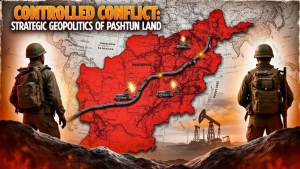
This struggle cannot be isolated from the global tug-of-war that seeks to dominate pivotal geographies for the coming half-century. Despite its landlocked nature, the Pashtun region occupies a critical geo-strategic position as a bridge between Central Asia and South Asia, with connective veins extending westward into the Middle East and eastward into South and East Asia. Its centrality makes it a juncture for continental integration, energy transit, and economic flows.
Energy Corridors and the Geopolitics of Pashtun Lands
One of the most underappreciated dimensions of this geography is its function as an energy corridor. Compared to Iran’s Chabahar port—which takes over 60 days and costs between $8,000–11,000 per container (Anadolu Agency, 2024)—the Afghanistan route via Pashtun lands requires a mere 40 days and approximately $5,000–8,000, making it an economically and temporally efficient trade route (Hellenic Shipping News, 2024).
Great Power Rivalry and Strategic Projects
The emergence of mega-initiatives such as China’s Belt and Road Initiative (BRI) and America’s Indo-Pacific Strategy further intensifies the geopolitics of Pashtun lands. The BRI explicitly integrates Afghanistan via the China-Pakistan Economic Corridor and seeks to extend infrastructure into Central Asia through this land bridge (FNF South Asia, 2023; Economic Times, 2024). Meanwhile, the U.S. Indo-Pacific Strategy, while centred on maritime Asia, includes efforts to secure influence and deter China’s expansionism into Central and South Asia (CNAS; Wilson Centre, 2024; RAND Corporation).
Additionally, the India-Iran nexus centred on the Chabahar port represents a strategic alternative to Gwadar and Afghan trade routes. However, it faces practical challenges in cost and time compared to the Afghanistan corridor (Anadolu Agency).
Rare Earth Resources and Strategic Competition
The conflict becomes even more complex when considering China’s geo-economic ambitions through BRI, which sometimes clash with Russia’s Eurasian Economic Union (EAEU), each seeking to shape Eurasia’s economic architecture. Scholarly assessments show both cooperation and rivalry between these powers (SAGE Journals, CSIS, Carnegie Endowment).
Moreover, geological studies by the U.S. Geological Survey (USGS) and British institutions reveal that Afghanistan, including the Pashtun areas, is rich in rare earth minerals—critical for the green energy transition. Deposits of lithium, cerium, lanthanum, and neodymium have been documented in provinces such as Helmand and Ghazni (Global Initiative, 2024; International Policy Digest). These elements are essential for electric vehicles, wind turbines, and other clean technologies.
Geopolitics, Sustainability, and New Colonialism
In today’s global power competition, sustainability and environmental security are replacing raw military force as long-term instruments of influence. Control over rare earth resources becomes a strategic imperative, explaining why regions rich in these materials often experience destabilisation. Thus, the geopolitics of Pashtun lands is not just about extremism or instability—it is a calculated contest for control, masked in development rhetoric but grounded in resource-centred motives.
د نړۍ زړونه سوځېدلي په دښمنۍ
موږ شمعونه کسان شو، پرته له ښکلا ژوندۍ
دا جګړه زموږ نده، بلکې د ماشوم په ځای
موږ د بل اور لپاره موښه لاره جوړوي
Translation:
The hearts of the world burned in enmity,
We became candles living without beauty.
This war is not ours;
It sacrifices us in others’ fires.
Consumer State vs. Strategic Partner: A Tale of India and Pakistan

Author is an MPhil scholar in International Relations at Quaid-i-Azam University with a strong foundation in political science and a passion for diplomacy, foreign policy, and conflict resolution, geopolitics analysis and security studies.