

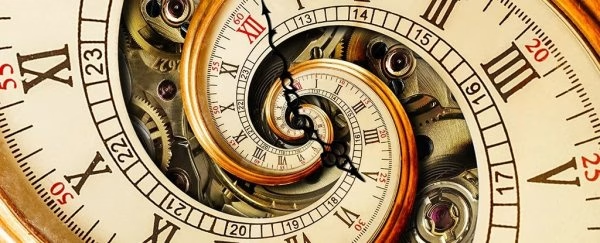
Almost everyone has felt it at least once. You are doing something ordinary, talking, walking, eating, and without warning, the moment feels strangely familiar. It is as if the scene has already played out before. The feeling passes quickly, but it leaves behind a quiet unease and a deep question. How could something so ordinary feel so repeated? This curious experience, known as déjà vu, has puzzled people for generations and has opened the door to far bigger questions about time, memory, and reality itself.
Déjà vu is often described as a mental glitch, but history is filled with accounts that go far beyond a passing sense of familiarity. Some people have claimed not only to recognize a moment, but to briefly step into another time altogether. One of the most discussed cases dates back to 1901, when two British teachers visiting Versailles reported an unsettling shift in their surroundings. The lively gardens grew silent, the atmosphere felt heavy, and figures in 18th-century clothing appeared before them. One woman, painting beneath a tree, bore a striking resemblance to Marie Antoinette. Moments later, everything vanished. This incident became known as the Moberly–Jourdain Affair and remains a cornerstone of so-called “time slip” stories.
Similar reports appear across cultures and centuries. In Scotland, a man claimed to see long-dead worshippers through a church window. An Italian soldier wounded in 1859 described waking in a hospital filled with technology that would not exist for another century. Farmers in Ireland spoke of Viking warriors crossing their fields, while a Japanese commuter in 1981 reportedly stepped into a medieval version of his own city for a few brief moments.
South Asia has its own share of such accounts. Near the deserts of Thatta, a traveler described encountering a Mughal-era caravan that dissolved into mist. In Kashmir, local legend tells of a shepherd who glimpsed ancient soldiers sleeping in a cave. A British officer in colonial Delhi recorded a moment when the modern market around him briefly transformed into a scene from the Mughal period, complete with soldiers, merchants, and elephants.
While these stories are anecdotal, they share a common thread: brief, vivid glimpses of another era, as if the boundary between moments in time thinned for an instant.
Physical discoveries add another layer to the mystery. Archaeologists use the term OOPArts, or Out of Place Artefacts, for objects that seem far too advanced for the time in which they were found. The Antikythera Mechanism, over 2,000 years old, functions like a complex astronomical calculator. Gold figurines from Colombia resemble modern aircraft in form. The so-called London Hammer was discovered encased in ancient rock, made from unusually pure iron. The Baghdad Battery hints at early electrical knowledge, while precisely drilled stones in Egypt and India challenge assumptions about ancient tools. Aluminium objects found in Romania are especially puzzling, since aluminium production requires electricity, something unknown in antiquity.
These anomalies force us to reconsider our assumptions about history, technology, and time itself.
Refinement Layer
For centuries, time was seen as a straight path: the past behind us, the future ahead. That idea began to change with the work of Albert Einstein, who demonstrated that time is flexible, capable of stretching and warping. Interestingly, similar ideas appear in the Qur’an, which repeatedly reminds us that time for Allah does not match time on Earth. A single divine day can equal thousands of human years.
Later thinkers took this even further. Erwin Schrödinger suggested that reality might not be limited to one timeline. From such thinking emerged the Block Universe Theory, which proposes that past, present, and future all exist at once, like pages in a book already written. We experience only one page at a time, but the entire book exists simultaneously. If consciousness briefly glimpses another “page,” the result could feel like déjà vu. If the overlap is stronger, it might appear as a full time slip.
This idea echoes religious concepts as well. The Qur’an speaks of a Preserved Tablet containing all events, past and future, known at once. While physics approaches this idea mathematically, religion frames it spiritually. Both, however, point toward time as something far richer than a simple forward march.
Modern theories go even further by proposing higher dimensions. Beyond the three dimensions of space and the fourth dimension of time, some mathematical models suggest up to ten dimensions are required for the universe to make sense. In such dimensions, time might behave in ways completely alien to human experience. Beings described in Islamic tradition, such as angels or jinn, are said to operate on different timelines, which could align with the idea of higher-dimensional existence.
Conclusion
Taken together, these experiences, artefacts, and theories suggest that reality is far more layered than it appears in daily life. Déjà vu may be a brief overlap between moments. Time slips could be rare cracks in our perception. Or perhaps both are reminders that time is not as rigid as we believe.
Whatever the explanation, these fleeting experiences continue to stir curiosity and wonder. They challenge the certainty of linear time and invite us to think more deeply about existence itself. In those brief moments when reality feels repeated or displaced, we may be brushing against a much larger and more mysterious structure of the universe, one that remains largely beyond human sight, yet never entirely out of reach.
Usman Ayub is an experienced journalist, anchor, and lecturer based in Islamabad. He has been associated with several national and international media organizations, including Tehzeeb TV, Alert, Zajil News (Dubai), IBC Ar/Ur/En and The Pakistan Gazette. Over the years, he has worked as a reporter, anchor, and news editor, and has also hosted religious programs. He is actively engaged in writing blogs and articles on social, educational, and religious issues.
Currently, Usman Ayub serves as a Lecturer of Arabic at the Academy of Languages and Professional Development, The University of Lahore.
Alongside journalism, he has contributed to social and welfare organizations as a media organizer and volunteer. His professional skills include reporting, research, content writing, video editing, team management, and strong communication skills.